
I began paying attention to how much of the day passed without my body changing position. Not in a dramatic way—just noticing how long I could sit before realizing I hadn’t moved at all. Once I started looking, I saw how many products now exist to interrupt that stillness: standing desks, treadmill desks, pedal attachments tucked under tables. Each one seemed to solve a slightly different problem.
I eventually settled on a FitDesk, mostly because it sat somewhere between options. It was less expensive than most treadmill desks and less specialized than a single-purpose pedal unit. What appealed to me was not the idea of “working out while working,” but the ability to shift positions without reorganizing the room or the day. Sitting, standing, pedaling lightly—all of it happened in roughly the same footprint.
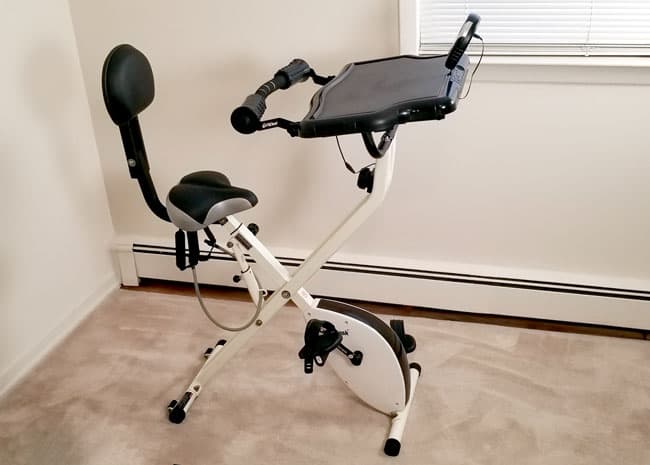
The FitDesk looks like a stationary bike with its handlebars replaced by a shallow, angled desk. The surface is large enough to hold a laptop or tablet without feeling crowded, and textured enough that things don’t slide when the pedals are moving. It doesn’t ask much coordination. Once everything is adjusted, the movement becomes background activity rather than the focus.
I tend to notice tools by how they behave when I’m not paying attention to them. The FitDesk is quiet. It doesn’t vibrate. It doesn’t require frequent adjustment once it’s set up. The resistance can be changed, but I usually leave it low when I’m reading or writing and increase it only when I’m watching something and don’t need my hands as much.
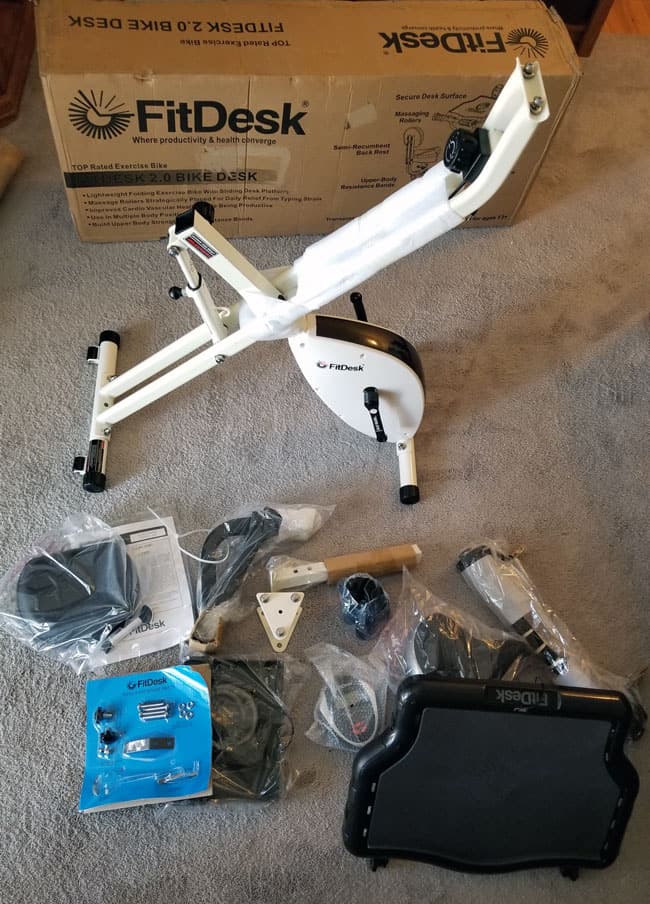
The frame arrived mostly assembled, which mattered more than I expected. The box was heavy, and moving it inside was its own small logistics problem, but once built, the desk felt stable. The wheels on the back make it possible to reposition, which is useful in a shared space. I’ve rarely folded it down, even though that option exists. It already occupies a predictable amount of room, and predictability tends to matter more than compactness.
The seat is wide, cruiser-style, with a padded backrest. I added an extra seat cover for comfort, but even without it, the seat felt designed for staying put rather than pushing hard. There are resistance bands attached under the seat for arm movement. I use them occasionally, and their presence doesn’t interfere with anything else.
There’s a small digital meter that tracks time, distance, and calories. I chose not to install it. I’ve learned that numbers change how I relate to tools, and not always in ways I find helpful. Still, the option is there, and the display is designed to be readable without leaning forward or squinting.
Over time, FitDesk has updated the platform design. Newer models include a lift-up compartment and optional desk extensions with a cup holder. Those changes make sense. The original surface works, but the idea of slightly more room—without changing the core structure—is appealing. It suggests the product has been shaped by how people actually use it.
FitDesk also now offers a version without the desk platform, intended for use at a traditional desktop workstation. That caught my attention for a different reason. It acknowledges that not everyone needs—or wants—the desk component, and that movement can be integrated into existing setups rather than replacing them.
As a tool, the FitDesk doesn’t transform the day. It doesn’t demand commitment or attention. It simply makes low-level movement possible while doing things I was already going to do. Over time, that quiet accommodation has mattered more than any feature list.
If you are interested in other ways to keep moving as we age, we have also written Under Desk Peddler for Upper Body Too and Qi Gong Can Help Seniors Keep Moving.